Dass in vielen Gebäuden jahrzehntelang kein Brand ausbricht, beweist nicht, dass keine Gefahr besteht, sondern stellt für die Betroffenen einen Glücksfall dar, mit dessen Ende jederzeit gerechnet werden muss!
Oberverwaltungsgericht Nordrhein-Westfalen Aktenzeichen: 10 A 363/86 Urteil vom 11. Dezember 1986
Das gleiche gilt für Kraftfahrzeugbrände!
aktuelle Situation und Problem
Den Daten des GDV zufolge ereignen sich in Deutschland jährlich rund 20.000 gemeldete Kraftfahrzeugbrände, was die ständige Relevanz effektiver Schutzmaßnahmen unterstreicht.
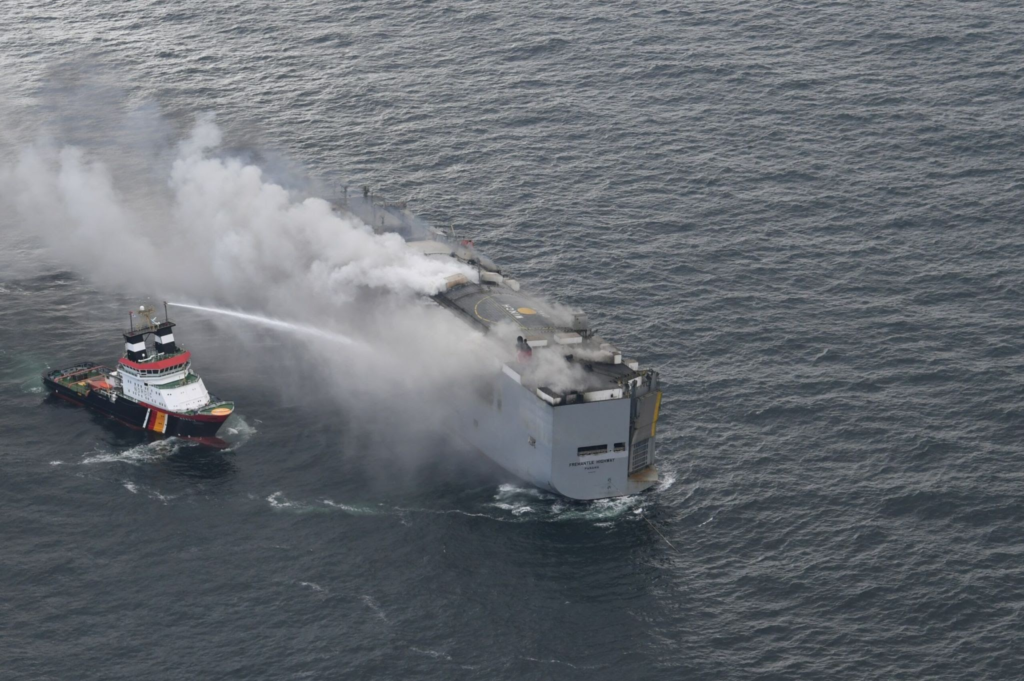
Solange ein Fahrzeugbrand lokal begrenzt bleibt, ist das Risiko oft kalkulierbar. Die Gefahr eskaliert jedoch massiv, wenn der Brand auf das Umfeld überspringt – sei es auf andere Kraftahrzeuge, die Bausubstanz von Parkgaragen oder angrenzende Naturflächen. Besonders kritisch ist es wenn brennende Kraftfahrzeuge Notausgänge behindern oder gar verhindern und/oder gar auf Gebäude übergreifen in denen sich Menschen befinden!
Einsatzbeispiele von Kraftfahrzeugbränden
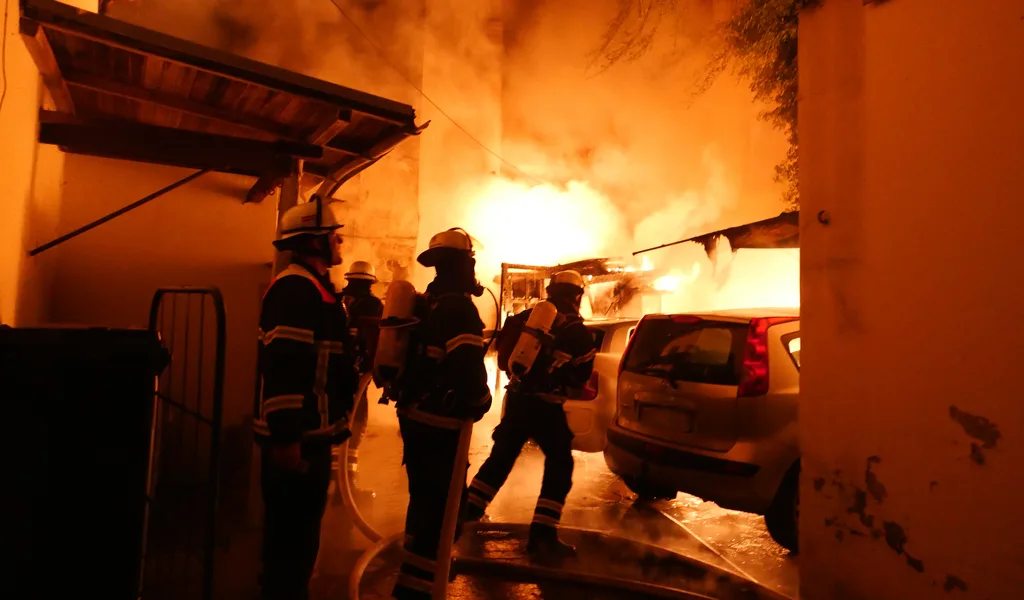
Wie zerstörerisch die Ausbreitung eines Fahrzeugbrandes sein kann, zeigte das Beispiel des Großfeuer in Hamburg-Rothenburgsort im April 2023 – der größte Brand in der Hansestadt seit dem Zweiten Weltkrieg – ausgelöst durch einen brennenden Pkw. Erst eine Woche nach Brandausbruch wurden die letzten Glutnester auf dem 17.000 Quadratmeter großen Gelände gelöscht. Mit dem Löschwasser gelangten Schadstoffe in den Billekanal.

Brand von 1300 Kraftfahrzeugen in Liverpool

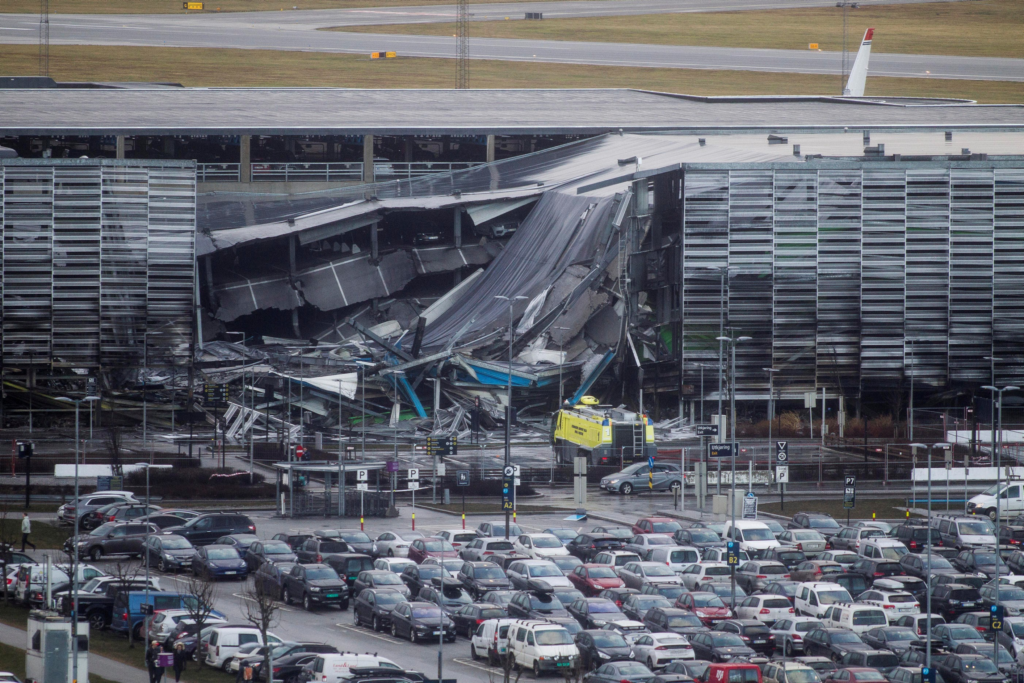
Brand von 200 Kraftfahrzeugen in Märsta
Brand von 60 Kraftfahrzeugen in Cork
Ein Brand in einem Apartmentkomplex bei Incheon treibt die südkoreanischen Aufsichtsbehörden derzeit um. 200 Familien mussten Anfang des Monats evakuiert werden, weil ein Mercedes in der Tiefgarage des Wohngebäudes in Brand geraten war. Es dauerte acht Stunden, den Brand zu löschen. 140 Autos wurden durch das Feuer zerstört oder beschädigt.
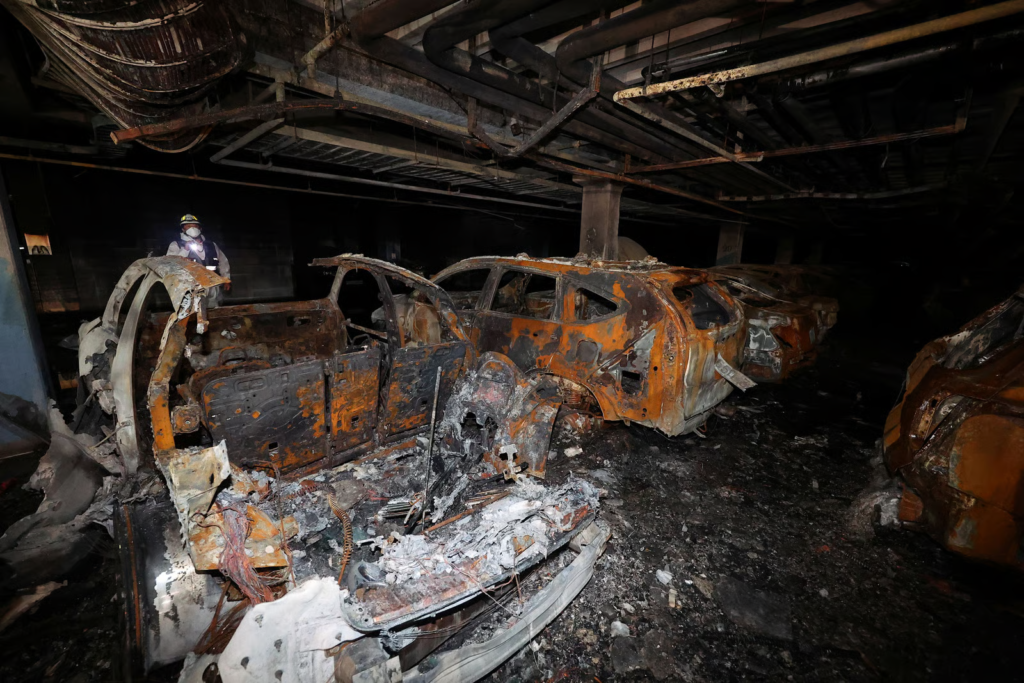
Nach Angaben der heimischen Feuerwehr- und Katastrophenschutzbehörde hat es in Südkorea zwischen 2013 und 2022 knapp 1400 Brände in unterirdischen Parkhäusern gegeben. Davon werden 43,7 Prozent Fahrzeugen zugeschrieben, wie aus einem Bericht von Februar hervorgeht.
Here’s the car that sparked a massive 1,500-vehicle fire at London airport car park – Autoblog
Luton Airport car park fire: More than 16000 customers contacted after blaze
Fire destroys 200 cars in Swedish car park
More Than 100 Cars Burned in Mass Arson Attack in Sweden – The New York Times
Gefahr für Einsatzkräfte
Angesichts der extremen Brandlast moderner Fahrzeuge und der rasanten Ausbreitung von Hitze und Rauch in Parkgaragen (offen oder geschlossen) ist es eine moralische und technische Notwendigkeit, Garagen mit funktionierenden Rauchabzügen und Löschanlagen auszustatten, oder kein Menschenleben für das Löschen von Kraftfahrzeugen zu riskieren!
https://www.mopo.de/hamburg/polizei/rauchsaeule-ueber-poppenbuettel-grossalarm-fuer-die-feuerwehr
https://www.presseportal.de/blaulicht/pm/82522/5750017
Lösungen
Schutz von Vegetationsflächen
Stellplätze an Vegetationsflächen bedürfen einer aktiven Prüfung und Freigabe durch die zuständigen Dienststellen (Forstamt, Grünflächenamt, …). Stellplätze dürfen nur dort zugelassen werden wo:
- eine Gefahr der Brandausbreitung durch ein brennendes Kraftfahrzeug auf die Vegetationsfläche ausgeschlossen werden kann oder
- der mögliche Abbrand der Vegetationsfläche als Schaden akzeptiert wird und versicherungstechnisch abgesichert ist.
Schutz von Gebäuden
Wenn eine externe Zündquelle und Brandlast – wie ein geparktes Fahrzeug – näher als 5 Meter an ein Gebäude rückt, erhöht sich das Risiko eines Brandüberschlags massiv. Um das Schutzziel der Landesbauordnungen (MBO § 14) zu erfüllen und ein Eindringen von Rauch und des Brandes in das Gebäude zu verhindern, dürfen Stellplätze nur dann durch die zuständigen Dienststellen (Bauordnungsamt, Straßenverkehrsamt, …) an Gebäuden zugelassen werden, wenn:
- die Stellplätze in Anlehnung an die MBO § 28 und § 30 in einem Mindestabstand von 5 m vorgesehen werden oder
- das angrenzende Gebäude bis auf 7 m Höhe eine
- nicht brennbare Fassade und Dämmung gemäß EN 13501-1 A1 oder A2-si, d0 hat,
- die Außenwand REI 30 – 90 entsprechend der Gebäudeklasse entspricht und
- Öffnungen in diesen Wänden EI 30 entsprechen.
Schutz von Flucht- und Rettungswegen
Ein notwendiger erster Flucht- und Rettungsweg darf nicht an der Gebäudeausgangstür enden, sondern muss bis in einen sicheren Ort im Freien gewährleistet werden. Dies ist in dem Maß zu berücksichtigen wie die Sicherheitsstandards im Gebäude durch das geltende Baurecht vorgeschrieben sind. In einem Radius von 5 m um einen Notausgang dürfen sich keine Parkplätze befinden.
Schutz in Garagen
Für den Schutz von Menschen und Einsatzkräften in Garagen sind die Maßnahmen der Gebäudesicherheitsrichtlinie zu beschließen.
Inhalte die noch zu überarbeiten sind
Intervention
As long as a car is not fully under fire, the firefighters must be able to scan a QR code, which needs to be on the front left and rear right side of the vehicles screens, in order to obtain data on potential threats of that specific car.
Vehicles with refrigerant R1234yf must be signed with dangerous good signs (corrosive and toxic). The Safety & Health Service (SHS) authorities must give clear standard operational procedures (SOP) on how to handle car fires with the release of fluoric acid released from R1234yf (Note: chemical suits used by fire & rescue services give no protection against fluoric acid!).
Open air car parks
A car burning in the open space maybe an advantage at best to be kept burning, in a controlled manner, so creating less amount of toxic fumes, rather than prevent fire spread. Tactical firefighting judgement would prevail.
- good access for fire appliances class 1 or 2 according the needs of the responsible Health & Safety Service
- fire hydrants at the longest distance not more than 75 m away
Enclosed car parks
Due to the great risk of fire spread and massive smoke build up, firefighting shall only be done if this Safety Action Plan has been considered. In any other case only direct fire fighting can be an option with specially trained (which must be available within at least 10 min after fire detection) including an additional trained rescue team and a good risk evaluation based on the Safety Concept of that car park.
Emergency plan
Owners of garages must provide the regional Safety & Health Service emergency plans according to their needs.
Fire detection and alarm system
Garages must have an automated fire detection system according DIN 14675 which is connected to a Public Emergency Call Answering and Alarming Centre. The fire detection system must give an audible warning and visible green flashing lights on top of every emergency exit door.
Radio communication
It must be guaranteed that the radio communication of the RESCUE Corps and the Police will work at all places in a garage.
Exceptions of this safety action plan
Open ground floor garages and closed ground floor garages for only a few cars can be freed of all or some parts of these regulations, if the regional Public Safety Service can’t see a fire and smoke danger towards other buildings, people and animals in the buildings and towards fire endangered areas. Exceptions can also be made for non public ground floor fleet parking garages.
statistics
The “exciting” data from the EU proves VERY little data is at least given to the EU. The only European data is from the UK with around 28.000 car fires in 2012.
Vehicle fires – Data Europa EU
Fossil fuel internal combustion engine cars burn more likely than zero emission vehicles
Facts and Myths About Fires in Battery Electric Vehicles
“All the data shows that EVs are just much, much less likely to set on fire than their petrol equivalent,” said Colin Walker, the head of transport at the Energy and Climate Intelligence Unit thinktank. “The many, many fires that you have for petrol or diesel cars just aren’t reported.”
“Australia’s Department of Defence funded EV FireSafe to look into the question. It found there was a 0.0012% chance of a passenger electric vehicle battery catching fire, compared with a 0.1% chance for internal combustion engine cars.”
New knowledge about battery fires in electric cars on ferries – CFPA Europe
Brann i biler – Elbiler brenner ikke oftere
A major insurance company in the United States recently conducted a study. Electric cars, according to the study, are in fact the least likely to catch fire. 25.1 out of every 100,000 electric vehicles sold caught fire. For the same number of combustion engine cars, 1,529.9 caught fire.
Fact Check: Do electric cars catch fire more often than combustion engine cars? – EDMO Belux
position paper on the fire protection of car parks – eurofeu position paper on the fire protection of car parks
https://www.evfiresafe.com/ev-fire-key-findings
Electric vehicle fire risk assessment framework using Fault Tree Analysis
very good video in German: Brennende E-Autos: Was steckt wirklich dahinter?
Threads due to Honeywells R1234yf refigerant
Safety sheet of R1234yf (sorry only in German)
R1234yf is
- a compound from the group of alkenes and organic fluorine compounds
- molecular formula C3H2F4
- a compressed, liquefied gas
- a flammable, highly flammable, colorless gas with a faint inherent odor
- rapid vaporization can lead to frostbite
- high vapor concentrations can lead to dizziness, nausea and even unconsciousness
flamability of R1234yf
- according to the Honeywell safety data sheet, R1234yf is described as a flammable gas
- the gas-air mixture is classified as highly flammable
- the explosion range is between 6.2 % LEL and 12.3 % LEL by volume
- the auto-ignition temperature is between 400 – 405 °C
- in the presence of temperatures above 400 °C (fire / contact with hot surfaces), R1234yf decomposes and forms hydrogen fluoride. Due to the ever-present humidity, hydrofluoric acid is also automatically produced
- The extremely widespread blue flame is typical of the combustion of R1234yf
- Flame detachment was increasingly observed during fire tests
- R1234yf is found in many vehicle air conditioning systems, car workshops, truck tanks, …
- Installation situation of air conditioning systems in the vicinity of hot components
- Components in the engine compartment up to 600 ºC
- Vehicle fire usually possible without accident
- Formation of hydrogen fluoride and hydrofluoric acid
- leaks due to defects in the cooling system can cause leaking refrigerant to form hydrofluoric acid and enter the vehicle interior via the ventilation system, thus endangering the occupants
- Leaks caused by accidents can directly endanger people involved in the accident and fire and rescue service personnel due to leaking hydrogen fluoride / hydrofluoric acid.
Threats due hydrofluoric acid
- Colourless, pungent smelling liquid
- Strongly corrosive to the skin, mucous membranes and conjunctiva of the eyes
- MAK value 3 ppm (2,5 mg/m³)
- Lethal dose > 1.5 g or 20 mg/kg body weight
- Contact poison which is absorbed by the skin
- it is possible that deep skin layers and even bones are damaged without an external wound being visible
- a palm-sized burn with hydrofluoric acid (40%) is usually fatal (palm of the hand approx. 1% of the body surface)
- interferes with the calcium and magnesium metabolism and thus affects the central nervous system (shock cramps)
- narcotic effect
- painkillers are almost ineffective
- the chemical protective suits of the fire department are not resistant to hydrofluoric acid and therefore offer no protection!
CO2 as cooling agent
- completely climate-neutral
- non-flammable (not to say fire-retardant), completely non-toxic
- approx. 20 – 30 € more expensive to buy for a new car, but approx. 400 € cheaper over the lifetime of a vehicle as no expensive monopoly refrigerant from Honeywell is needed
CO2 has the following positive properties in comparison:
- non-toxic
- non-flammable
- no ozone depletion potential
- chemically inactive
- no separate disposal necessary
- inexpensive
With this in mind, it is necessary to adapt the current EU directive, ban R1234yf and make CO2 mandatory.
Statistics from Germany 2009
- 2.3 million traffic accidents on German roads
- 40,000 vehicle fires
- 1% (400) of vehicle fires are caused by serious collisions
- 50.2 million vehicles officially registered in Germany (01.01.2010)
- 96% equipped with air conditioning
- Average filling quantity per car approx. 625 g
- 23,645 tons of refrigerant in cars on German roads alone
- According to estimates, 10% of the refrigerant used evaporates due to leaks, improper refilling or accidents
- annual turnover of the chemical industry in refrigerants approx. 4 billion €
external links about the threat of R1234yf
http://www.rp-online.de/leben/auto/news/warnung-vor-gift-in-auto-klimaanlagen
http://www.autobild.de/artikel/auto-klimaanlagen-gefaehrliches-kaeltemittel-hfo-1234yf
http://www.kabeleins.de/tv/k1-magazin/videos/clip/klimaanlage-toedliche-gefahr
http://www.duh.de/klimaanlage_film.html
Autoklimaanlagen mit fluorierten Kältemitteln | Umweltbundesamt
http://www.duh.de/pressemitteilung.html?&tx_ttnews
http://www.wdr.de/tv/markt/sendungsbeitraege/2010/1004/download/WDR-markt-101004.pdf
Kältemittel R1234yf: Explosiver Klimaschutz – DER SPIEGEL
Kühlmittel R-1234yf: Autos erhalten gefährlichen Kaltmacher | STERN.de
http://www.auto-motor-und-sport.de/news/brennbares-kaeltemittel-fuer-klimaanlagen-690631.html